

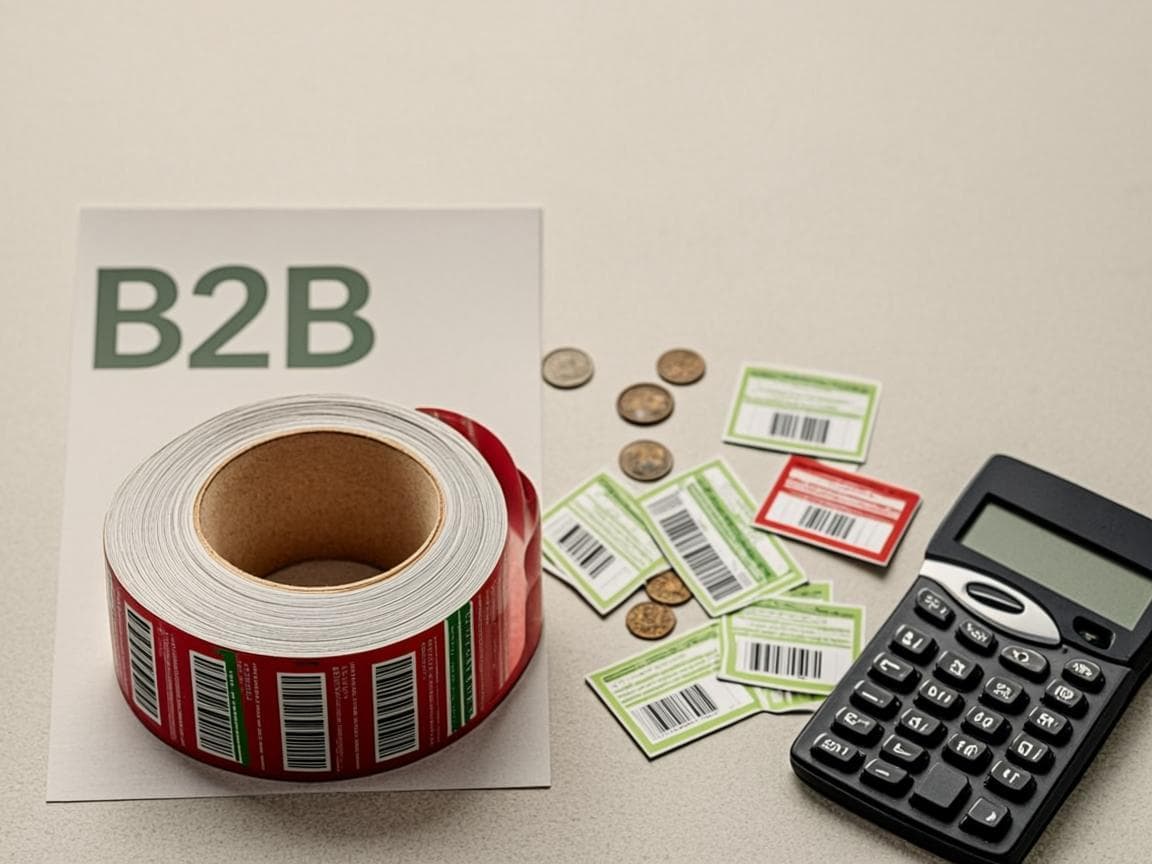
The industrial buyer evaluating label suppliers faces a recurring mirage: digital printing’s per-thousand price list looks lower than flexography on small runs, but the cost curve flips dramatically from 15,000–20,000 labels onward. This guide breaks down the real total cost of ownership (TCO) of both technologies, compares them against manual UV DTF shops, and delivers a practical calculator so the purchasing director makes the right decision by volume.
The Digital Mirage Effect
Public digital printing price lists per thousand show prices that look competitive: at $750.84 MXN per thousand ($0.75 per label), white at $831.28 MXN ($0.83 each), transparent BOPP at $911.73 MXN ($0.91 each), metallized BOPP at $1,018.99 MXN ($1.02 each), and ultra-adhesive at $1,367.59 MXN ($1.37 each). These prices are real for runs of 100 to 5,000 labels. The problem is that the cost of ink per square meter and digital print head wear don’t scale: the price per thousand stays constant or even rises with volume, because a digital press prints at the same speed regardless of quantity.
Breakdown of the reference digital price list
Public digital printing price list per thousand (MXN, market benchmark)
These prices do NOT include design cost, , special finishes (laminate, , ), or roll handling. Add them up, and the real cost per digital label can exceed $2.00 MXN on medium runs — versus $0.15–$0.40 MXN in flexography for the same volume.
The UV DTF Sticker Myth
Flatbed UV DTF shops offer stickers at $2.00–$5.00 MXN per piece. For small volumes (100–500 pieces) or special-edition products, it’s a valid option. But for industrial rolls on high-speed automatic applicators (60–120 labels per minute), UV DTF’s manual or semi-manual process is unworkable: every label must be peeled and applied by hand, it doesn’t come in a continuous roll, and the mechanical strength of UV adhesive isn’t designed for automated packaging lines.
- 60%
- Profitability loss on digital vs flexo at 50k+
- 15,000
- Inflection point (labels) where flexo wins
- $0.15
- Cost/label flexo at 100k (vs $0.83 digital)
- 120/min
- Automatic applicator speed (requires roll)
Mechanical Strength and Behavior on the Line
Flexographic UV ink polymerizes (cures) instantly on the substrate, forming a layer that withstands friction on conveyor belts, contact with greases and oils, and passage through pasteurization or heat-shrink tunnels (up to 180°C for 3 seconds). Digital ink (inkjet or toner) is deposited on the surface without penetrating the substrate, which makes it susceptible to scratching, abrasion, and transfer on contact.
B2B Scale Return Calculator
Use ETIVAL’s interactive tool to calculate your net savings from migrating from digital thousands to roll flexography. Enter your monthly volume, current material, and finishes — you’ll get the break-even point and projected savings over 12 months.
The interactive quote calculator estimates by technology, material, finish, and volume.
Conclusion: the golden rule of volume
The practical rule is straightforward: below 10,000 labels, digital printing is the right choice (no plate cost, 48-hour turnaround). Above 20,000, roll flexography wins on unit cost, mechanical strength, and application speed. Between 10,000 and 20,000 lies the gray zone where the break-even depends on material and finishes — and where ETIVAL’s technical advisory makes the difference.
ETIVAL Editorial Team
We manufacture for all of Mexico · ISO 9001:2015
More guides
Apply this to your project.
A technical advisor reviews your case in under 24 business hours.