

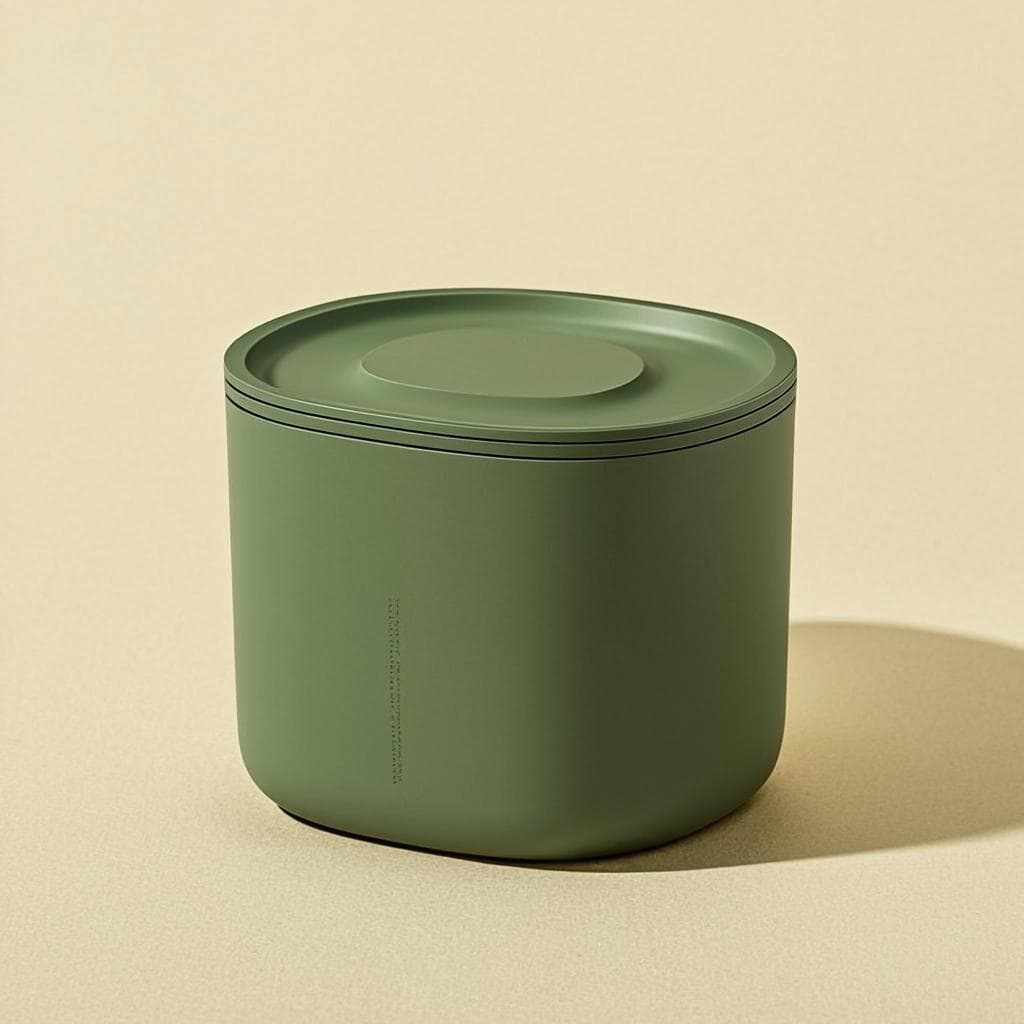
IML (In Mold Labeling) is the technology in which the label is placed inside the injection or blow mold and becomes fused to the container wall during its manufacture: it is not a layer glued on afterwards, but part of the piece itself. An IML label does not peel off, does not wrinkle, and completely eliminates the downstream labeling step — the container comes out of the mold already decorated.
In Mexico, Etival Etiquetas (plant in the Valley of Mexico) manufactures labels in coextruded polypropylene with an ink-receptive layer, printed in flexography with up to 8 inks, for rigid PP and PE containers. Runs from 30,000 labels, delivery in 15 business days on new projects, and quotation in under 24 hours.
How it works, step by step
- 01Flexographic printing of the label on coextruded PP film — structural layer + ink-receptive layer — with up to 8 inks and the same color control as a conventional label.
- 02Loading into the mold: a placing robot (or a static charging system) deposits the label held against the inner walls of the injection or blow mold, in exact position.
- 03Container forming: the molten polypropylene fills the mold (or the parison is blown against its walls) and the heat and pressure weld the label's outer layer to the container wall.
- 04Cooling: label and container emerge fused into a single piece of the same material — no adhesive, no edge, no intermediate layer.
- 05Demolding: the piece comes out finished and decorated. There is no downstream labeling line: zero labelers, zero handling of the artwork.
Advantages of IML
- Permanent by nature: fused to the wall, it withstands friction, moisture, greases, , and removal attempts — the natural choice for returnable containers and heavy-duty use.
- Zero labeling line: the container comes out of the mold decorated; the labeler, its maintenance, its staff, and its production bottleneck are eliminated.
- Monomaterial recycling: a PP label on a PP container — the whole container enters a single recycling stream with no prior separation, an increasingly common requirement in circular-economy programs.
- Total chemical resistance: moisture, oils, greases, and the chemicals in the contents do not degrade the artwork, because there is no adhesive to attack.
- High-resolution print quality: halftone detail, gradients, and finishes with the same flexographic standard of the house — IML does not sacrifice aesthetics for resistance.
IML vs. pressure-sensitive label
Technical comparison for rigid PP and PE containers
When IML makes sense
- Rigid PP containers already being molded: premium ice cream tubs, butter, margarine and spreads, paint or adhesive pails and buckets.
- Returnable, intensive-use containers — catering, industrial — that get washed and handled without the artwork deteriorating.
- Brands with a monomaterial recycling goal: IML is the direct route to the single-stream container.
- Injection-molded parts subject to heavy handling: caps, retail boxes, rigid cosmetic jars.
And when it doesn't: IML requires that the container be manufactured by injection or blow molding with an adapted mold (label plates or a placing robot). If you buy containers already molded by a third party without an IML line, you work with flexible containers or non-molded surfaces, or your volumes sit below the 30,000-piece minimum run, the pressure-sensitive label remains the right route — simpler and more economical at low volumes.
Technical requirements before printing
An IML project is defined in direct coordination with the molder: mold geometry and label-holding system (static or vacuum), the correct coextruded film for PP or PE according to the process, and a fusion test before the run. At ETIVAL these checks are included in the brief's technical analysis, with physical samples to validate the result on your own piece.
The technical analysis includes a compatibility check against your mold.
ETIVAL Editorial Team
We manufacture for all of Mexico · ISO 9001:2015
More guides
Apply this to your project.
A technical advisor reviews your case in under 24 business hours.